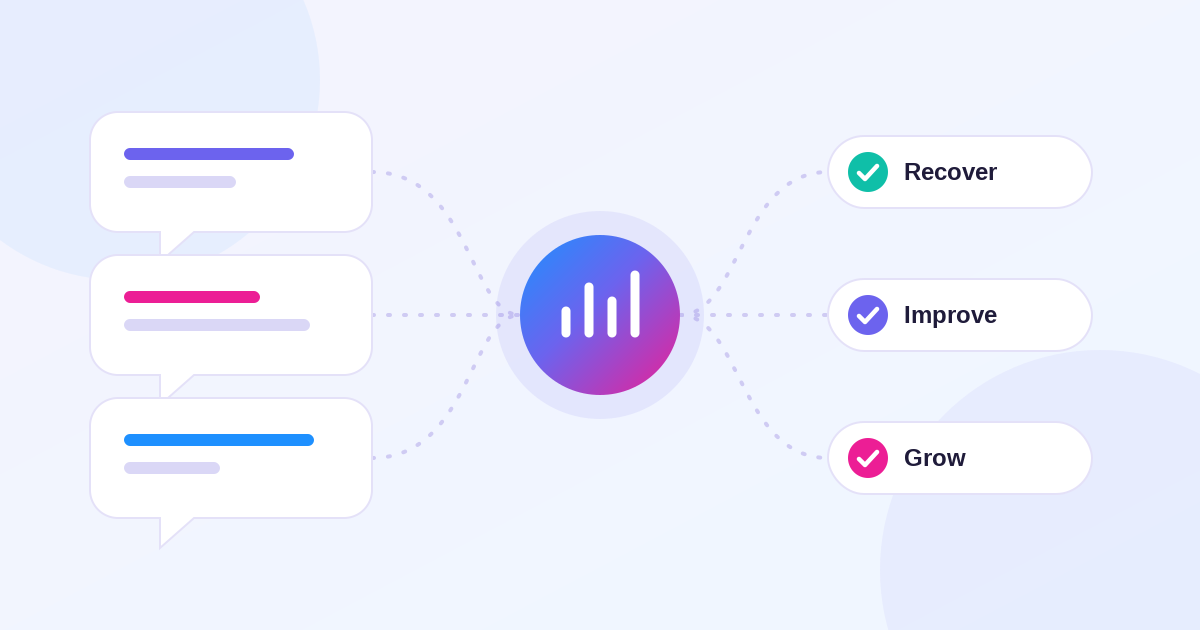
Every business hears from its customers: in surveys, in reviews, in calls to the service centre, in what people tell staff at the counter. Voice of Customer is what turns that scattered feedback into something the business can use. It is less a tool than a discipline, with a clear beginning and a clear end: it starts when a customer says something, and it is finished only when something has been done about it.
What is Voice of Customer (VoC)?
Voice of Customer (VoC) is the practice of collecting what customers say about their experience, understanding what it means, and acting on it. A VoC program is the set of moments, questions, channels and processes a company uses to do that consistently.
The term covers three things that are often confused:
- The feedback itself: the scores, comments, reviews and conversations.
- The program: how and when the company asks, and who sees the answers.
- The outcome: what changes for the customer and for the business as a result.
A company that only has the first has data. A company that has all three has a VoC program.
Why does Voice of Customer matter?
Internal data shows what customers did. Only customers can say why. A sales report shows that visits to one branch are falling; the customers of that branch can tell you it is the wait at the till.
- It finds problems early. A complaint in a comment today is a lost customer next quarter. Feedback is usually the first place a problem becomes visible.
- It protects individual relationships. An unhappy customer who is contacted quickly can often be won back. One who is ignored rarely returns.
- It directs investment. Knowing which parts of the experience drive satisfaction shows where improvement will pay off, and where it will not.
- It makes performance comparable. The same questions asked across locations, teams and time show who is delivering on the brand promise.
Where does customer feedback come from?
Feedback reaches a company in three ways. A complete picture uses all of them.
| Type | What it is | Examples |
|---|---|---|
| Direct | What customers tell you when you ask | Surveys after a purchase or a visit, feedback forms, interviews |
| Indirect | What customers say without being asked | Online reviews, social media posts, calls and messages to support |
| Inferred | What customer behaviour suggests | Repeat purchases, cancelled orders, visits that stop |
Direct feedback is the easiest to act on, because you choose the moment and the question, and you know which customer and which interaction the answer belongs to.
What are the stages of a VoC program?
A working program moves through the same stages every time a customer responds.
Short, relevant conversations that adapt to each response — on any channel.
AI reveals theme, sentiment, urgency and the reason behind the score.
Each customer is routed to the most relevant next step — recover or grow.
Teams track trends, accountability and business impact over time.
- Ask at a meaningful moment. Right after a purchase, a visit, a delivery or a service call, while the experience is fresh. See how the flow works.
- Adapt to the answer. A customer who gives a low score should be asked what went wrong. A customer who gives a high score should not be asked the same thing. Adaptive feedback keeps the conversation short and relevant.
- Understand the meaning. Scores say how customers feel. Their own words say why. Reading open text at scale is the work AI is suited to.
- Trigger the right action. Each response should lead to a next step: a recovery case, a thank-you, a request for a review, a task for a manager. This is what feedback-based actions are.
- Close the loop and learn. Tell the customer what was done, and feed what was learned back into how the business runs.
Which metrics does a VoC program use?
Most programs track one or more of three scores: Net Promoter Score for loyalty, Customer Satisfaction Score for a single interaction, and Customer Effort Score for how easy a task was. Each answers a different question, and none of them explains itself. Our guide to NPS, CSAT and CES covers what each one can and cannot tell you.
The score is the start of the conversation. What makes it useful is the comment beside it and the action that follows.
What are the most common mistakes in VoC programs?
- Measuring without acting. A dashboard that nobody acts on teaches customers that answering is pointless, and response rates fall.
- Asking too much. Long surveys are answered by fewer people, and with less care. One score and one open question is often enough.
- Asking too late. A survey that arrives a week after the visit measures memory, not experience.
- Ignoring the comments. The reason behind a score is in the open text. A program that reports only numbers knows that something is wrong and not what.
- Keeping it in one department. Feedback about a branch belongs with the branch manager, not only in a head-office report.
How do you start a VoC program?
- Pick one moment that matters, such as the end of a purchase or a service visit, and start there.
- Ask one score question and one open question. Keep it under a minute.
- Decide in advance what happens to each kind of answer. Who is told about a low score, how fast, and what they are expected to do. This is the heart of service recovery.
- Give the results to the people who can act on them, by location and by team. See multi-location performance.
- Expand once the loop works. Add moments and channels only when the first one reliably leads to action.
Voice of Customer is not the act of listening. It is the habit of doing something with what was heard, every time.