Ask a customer for a score and you learn how they feel. Ask them one open question and you learn why. The second answer is the valuable one, and it is also the one most companies do the least with. Comments pile up in an export that someone means to read. This article explains why that happens, why the usual shortcuts do not solve it, and what AI changes.
Why is open-text feedback so valuable?
Open-text feedback is what customers write in their own words when a question does not limit their answer. It is valuable for three reasons.
- It carries the reason. A score of 4 out of 10 says a customer is unhappy. "I waited twenty minutes and nobody told me why" says what to fix.
- It surfaces what you did not ask about. A closed question can only confirm what you already suspected. An open one lets customers raise the issue you had not thought of.
- It is specific. Customers name the product, the branch, the step in the process and sometimes the person.
Why can people not simply read the comments?
They can, when there are fifty. The difficulty is everything that happens when there are fifty thousand.
- Volume. A business with many locations and many daily transactions receives more comments than any team can read. The usual answer is to read a sample, which means most customers who wrote something are never read at all.
- Consistency. Two people tag the same comment differently, and the same person tags it differently on a Monday and a Friday. Trends built on inconsistent labels are not trends.
- Speed. A comment that asks for help is urgent when it is written. Read in a monthly review, it is a customer who has already left.
- Attention. Readers remember the vivid complaint and miss the quiet pattern: the small issue mentioned by a few customers in every branch.
Why are keywords and word clouds not enough?
The first attempt at automation is usually a list of keywords, or a word cloud. Both count words, and words are not meaning.
- The same thing is said in many ways. "Slow", "took forever", "still waiting" and "twenty minutes" are one theme and four keywords.
- The same word means opposite things. "The wait was fine" and "the wait was unacceptable" both contain "wait".
- Negation and tone are invisible. "Not bad at all" is counted as "bad".
- One comment holds several topics. "Great staff, but the price is too high" is praise and a complaint at once.
- Customers do not write neatly. They misspell, abbreviate and mix languages.
- A list only finds what it was told to look for. A new problem has no keyword yet.
What does AI do with open-text feedback?
Modern language models read a comment for its meaning, the way a person does, and do it for every comment, as it arrives. In practice that makes five things possible.
“Waited 40 minutes, nobody updated me, done ordering here.”
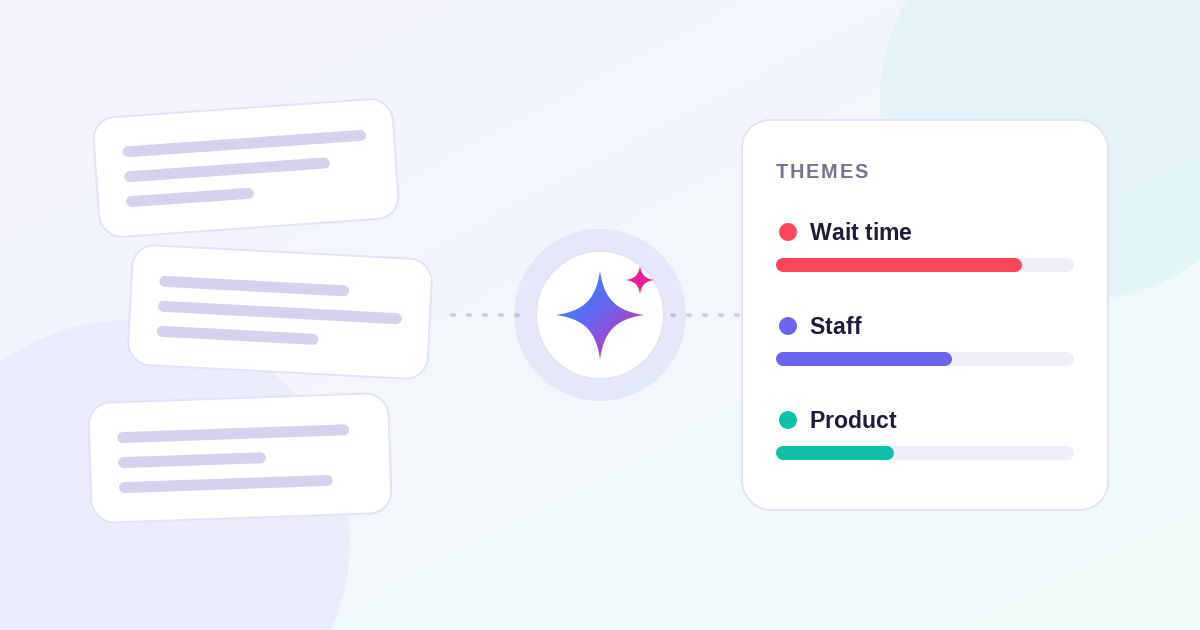
- Themes. Each comment is assigned to the topics it is about, however they were phrased, so that "took forever" and "still waiting" are counted together.
- Sentiment, per topic. The same comment can be positive about staff and negative about price, and each is recorded separately.
- Intent and urgency. A comment that asks for a call back, or mentions leaving, is recognised as needing a response now.
- Emerging signals. An issue that starts to repeat is noticed while it is still small, without anyone having defined it in advance.
- Summaries. Thousands of comments become a short, readable account for an executive, a region or a single location.
The result is that the drivers behind a score sit next to the score. This is what AI does in the Howazit platform, and it is what turns analytics from a report of what the number is into an explanation of why.
What changes when every comment is read?
- Nothing depends on a sample. Every customer who wrote something is heard.
- Urgent comments are acted on in time. A comment that signals risk can open a service recovery case straight away.
- Priorities rest on evidence. Themes can be ranked by how often they appear and how strongly they move the score.
- Locations can be compared on causes, not only on results. Two branches with the same score may have entirely different problems.
- Surveys can be shorter. When open text is understood, there is less need for a long list of closed questions to guess at the reason. See adaptive feedback.
What should stay with people?
AI reads and organises. It does not decide what the business should do. Three things remain human work.
- Judgement. Which theme to address first, and how, depends on strategy and cost, which the comments do not contain.
- Checking. Any model can misread a comment. Results should be reviewed, especially at the start and whenever something surprising appears.
- The conversation. AI can help draft a consistent reply; a person should own the relationship with an unhappy customer.
Customer comments also contain personal information, so how they are processed matters. See our approach to responsible AI.
How do you start analyzing open text with AI?
- Ask an open question. One, after the score: "What is the main reason for your answer?"
- Analyze every comment, not a sample, and as it arrives.
- Keep the context attached. A comment means more when it is read together with the location, the product and the kind of interaction it belongs to.
- Connect themes to owners. A theme about waiting times belongs with operations; a theme about pricing belongs elsewhere.
- Tie urgency to action. Decide what happens when a comment signals risk, and make it happen automatically.
Customers have always explained themselves. What is new is that a business can now read all of it, understand it, and respond while it still matters.