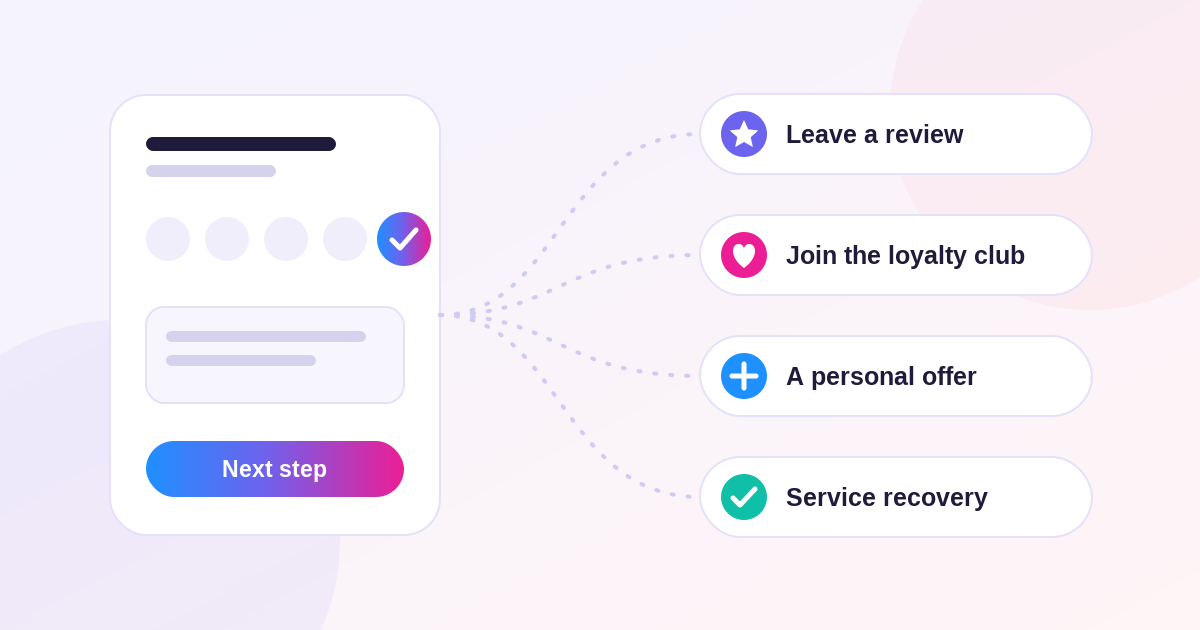
Getting a customer's attention is hard, and it is getting harder. A customer who opens a feedback request and starts to answer is giving a business something rare: a minute of real attention, about an experience they have just had. Most feedback programs spend that minute collecting a score and saying thank you. Drive to Action is the idea that the minute should be used, while it lasts.
What is Drive to Action (DTA)?
Drive to Action (DTA) is the practice of moving a customer to the right next step while they are still answering a feedback request, based on what they have just said and on what the business already knows about them. The feedback is not the end of the interaction. It is the trigger for the next one.
In Howazit, each customer gets their own next action. It is chosen from their answers, their history, and their details from systems such as the CRM, so two customers who give the same score can be led to two different places.
Why act while the customer is still answering?
Because that is when the customer is there. A follow-up email sent the next day has to win the customer's attention all over again, and usually does not. During the feedback conversation the customer is already engaged, the experience is fresh, and a relevant suggestion feels like part of the conversation and not like a campaign.
Acting in real time also changes what is possible. A problem raised now can be handled before the customer leaves, and a happy customer can be asked for a review while they still feel like writing one.
What decides each customer's next action?
A next action is only useful if it fits the customer. DTA draws on four kinds of information.
Alert the store manager
Ask for a review
Tag and route the theme
- What the customer just answered. The score, the comment, and what the comment is about.
- Their history. Previous visits and purchases, previous feedback, and how earlier issues ended.
- Who they are to the business. Details from the CRM, the loyalty program or the point of sale: whether they are a member, how often they buy, what they bought this time. See integrations.
- The business's own rules. What may be offered, to whom, and who must be told.
The same engine that adapts the questions to each answer is what adapts the outcome.
What happens when a customer is happy?
A satisfied customer is at the moment they are most willing to do something for the brand. DTA offers them a supportive action that suits them, for example:
- writing a review on Google or Yelp,
- sharing their experience on social media,
- joining the loyalty program, if they are not yet a member,
- an upsell or cross-sell offer that fits what they bought,
- an invitation to come back sooner.
Which one depends on the customer. There is no point inviting an existing member to join the loyalty program, or asking for a second review from someone who wrote one last month. This is how promoters turn into reviews, loyalty and revenue.
What happens when a customer is unhappy?
When the answers show a poor experience, DTA starts service recovery automatically. The customer is not left with a thank-you screen.
- The right people are told at once, with the customer's answers and context attached.
- Some issues can be resolved on the spot, within the business's procedures: an apology and compensation that the rules allow, offered in the same conversation.
- The response fits the customer's record. A loyal customer with a first complaint and a customer who complains after every visit are different cases, and the business can decide in advance how each is treated.
The aim is a second chance. In Howazit's experience, about 30% of dissatisfied customers are at risk of leaving. Recovery that begins while the customer is still in the conversation is the best opportunity to keep them.
Why does Drive to Action matter to the business?
It lets a business gain more from the customers it already has.
- More value per customer: a larger basket, a shorter time between visits, a new loyalty member.
- More reviews and referrals, from customers who were happy and were asked at the right moment.
- Fewer lost customers, because a poor experience is answered while it can still be put right.
None of this needs new customers or a new channel. It uses a moment the business already has, and currently spends on a thank-you page.
Why does it matter to the customer?
Because the customer can tell the difference between being surveyed and being heard. A response that reflects what they said, and who they are, shows that the answer went somewhere. They are treated as a person, not as one more completed survey, and that is itself part of the experience they will remember.
How is Drive to Action different from a dashboard?
Most feedback programs work from the top down. Responses are collected, added up, and shown on a dashboard, where someone looks for patterns and decides what to change. Drive to Action starts from the other end.
| Dashboard first | Drive to Action | |
|---|---|---|
| Starts from | The total | The individual customer |
| When something happens | After the results are reviewed | During the conversation |
| What the customer gets | A thank-you message | A next step chosen for them |
| The big picture | The goal | Built from every individual experience |
The big picture is not lost. Every personal interaction is also a data point, so the scores, drivers and trends are still there. The business earns twice: once from each customer it acted for, and again from what all of those interactions show together.
How do you start with Drive to Action?
- Choose two outcomes to begin with: one for a happy customer, such as a review request, and one for an unhappy customer, such as a recovery case.
- Connect the customer data you already have, so the action can depend on more than the score.
- Write the rules down. Who gets which action, what may be offered, and who is notified. See feedback-based actions.
- Measure the actions, not only the answers: reviews written, members enrolled, customers recovered.
- Add outcomes as you learn which ones customers take up.
A customer who answers has already done their part. Drive to Action is how the business does its own, in the same minute.