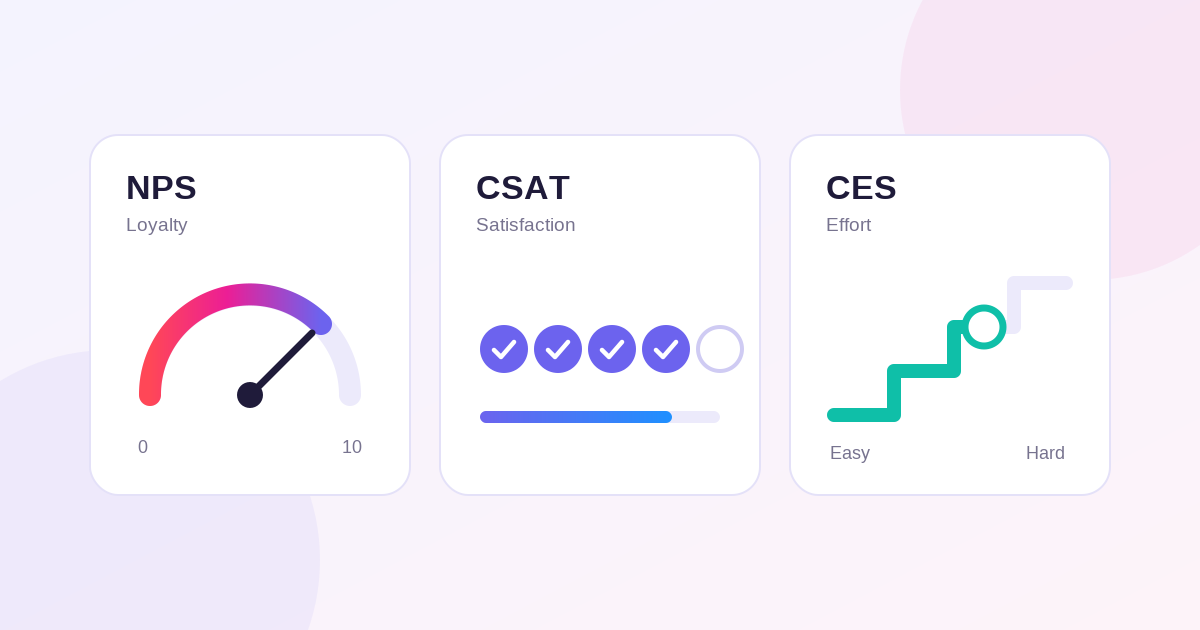
Most customer experience programs report at least one of three numbers: NPS, CSAT or CES. They are often shown side by side on the same dashboard, as if they were three views of the same thing. They are not. Each one asks a different question, at a different moment, about a different part of the customer's experience, and each one goes quiet on exactly the things the other two are good at.
This guide explains what each metric measures, how it is calculated, what it can tell you and what it cannot, and how to choose between them.
What is the difference between NPS, CSAT and CES?
The three metrics differ in the question they ask and in what that question is about: the relationship, a single interaction, or the effort a task required.
| Metric | The question | What it measures | Best asked |
|---|---|---|---|
| NPS | How likely are you to recommend us to a friend or colleague? | Loyalty to the brand as a whole | Periodically, or after a meaningful milestone |
| CSAT | How satisfied were you with this experience? | Satisfaction with one specific interaction | Right after the interaction |
| CES | How easy was it to get this done? | The effort a task required | Right after a task, such as a support request or a return |
What does NPS tell you, and what does it miss?
Net Promoter Score (NPS) measures how likely customers are to recommend a company. Customers answer on a scale from 0 to 10. Those who answer 9 or 10 are promoters, 7 or 8 are passives, and 0 to 6 are detractors. The score is the percentage of promoters minus the percentage of detractors, so it runs from -100 to +100.
What NPS can tell you
- How the overall relationship is trending over time.
- Which customers are most likely to recommend you, and which are at risk.
- How locations, regions or segments compare on the same question.
What NPS cannot tell you
- Which interaction caused the score. A detractor may be reacting to a delivery last week or to a price change last year.
- What to fix. The number carries no reason on its own.
- What happened today. NPS moves slowly, so it is a poor alarm for a problem that started this morning.
What does CSAT tell you, and what does it miss?
Customer Satisfaction Score (CSAT) measures how satisfied a customer was with one specific interaction. It is usually asked on a five-point scale, from very dissatisfied to very satisfied, and reported as the percentage of answers in the top two points.
What CSAT can tell you
- How a particular touchpoint is performing: a purchase, a visit, a delivery, a support call.
- Whether a change to that touchpoint made it better or worse, and quickly.
- Which individual customers just had a poor experience and need a response.
What CSAT cannot tell you
- Whether the customer will stay. A customer can be satisfied with every single interaction and still leave for a competitor.
- How the relationship feels as a whole. CSAT reflects a moment, and moments do not always add up.
What does CES tell you, and what does it miss?
Customer Effort Score (CES) measures how easy it was for a customer to get something done. A common form asks customers how much they agree with a statement such as "The company made it easy for me to handle my issue", on a seven-point scale. It is reported as an average, or as the percentage who agree.
What CES can tell you
- Where the friction is: the form that takes too long, the issue that needs three contacts to resolve.
- Which processes to simplify first.
What CES cannot tell you
- How the customer feels about the brand. An easy process is not the same as a loyal customer.
- Anything about experiences that are not tasks. Effort is the wrong question for a restaurant meal or a hotel stay, where the customer did not come to complete a process.
Which metric should you use, and when?
Choose the metric by the decision you need to make, not by the number you would like to report.
- Use NPS when the question is about the relationship: are customers becoming more or less loyal, and where?
- Use CSAT when the question is about a touchpoint: did this visit, order or call go well?
- Use CES when the question is about a process: how hard is it to get this done?
Most programs end up using two or all three, each at the moment it fits. What rarely works is asking all three at once. A longer survey gets fewer answers, and the answers it does get are less considered.
Why is a score on its own not enough?
All three metrics share one limit: a score tells you that something happened, never why. A 6 out of 10 says a customer is unhappy. It does not say whether the reason was the wait, the price, the product or the person who served them.
The reason lives in the customer's own words. That is why each score question works best when it is followed by one open question, and why the open-text answers need to be read at scale, not sampled. Reading them is the part AI is practical for: grouping thousands of comments into themes, so the drivers behind a score are visible next to the score itself.
How do you turn a score into action?
A metric earns its place when something happens because of it. In practice that means three things.
- Ask at the right moment. A question sent while the experience is fresh gets more answers, and more accurate ones. Short conversations that adapt to each answer keep the survey brief for everyone and specific for the customer who has something to say.
- Attach a next step to every answer. A low score should open a service recovery case while the customer can still be won back. A high score is the right moment to ask for a review or offer a reason to return. This is what feedback-based actions are for.
- Track drivers, not just the number. Reporting the score alongside the themes behind it, by location and over time, shows what to fix and whether the fix worked. See analytics and performance.
NPS, CSAT and CES are instruments. Each is accurate about one thing and silent about the rest. Used together, at the right moments, and connected to an action, they stop being a report and become a way of running the business.